
IB Mathematics: Applications and Interpretation SL
Write it by hand.
Marked like the real IB.
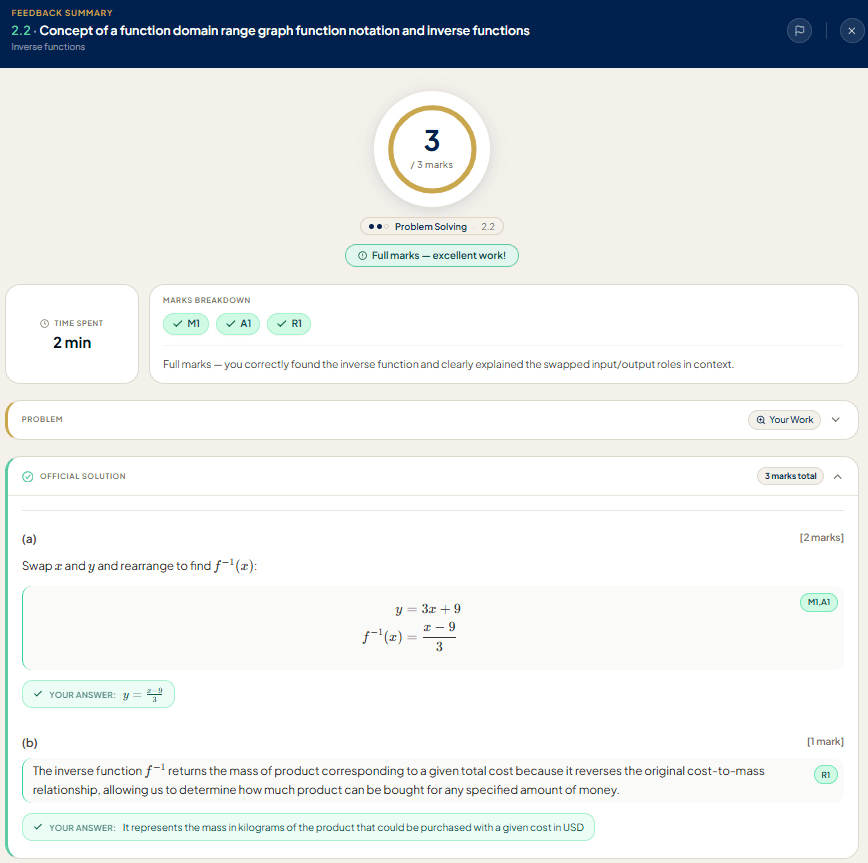
AscentIQ generates a fresh exam-style exercise every time — never from a bank — then reads your handwritten solution and awards marks the way an IB examiner does. M1, A1, R1, with a reason for every single one.
Full access to every topic for 7 days. No card required.
Sequences & series
Seed 4Q81
A gym opens with 2 members in its first week. Membership grows by 5 members each week.
- (a)Find the number of members in week 10.
- (b)Justify why an arithmetic model is appropriate here.
Your work
u₁₀ = 2 + (10 − 1)(5)
= 2 + 45
u₁₀ = 47 members
Marks awarded
- M1Mark awarded. Correct method: substituted n = 10 into the formula.
- A1Mark awarded. Correct value: 47.
- R1Mark not awarded. No justification given for the choice of model.
Why this isn't a question bank
You only solve a question once.
After that, you're remembering it.
Work a question, get it wrong, understand why — and that question is spent. Come back to it next week and you aren't doing the maths, you're recalling what you wrote. What builds the skill is the same structure with different values, again, until the method is the thing you reach for. Past papers run out. Textbook exercises run out. A generated exercise doesn't.
Static question banks
Spent after one attempt
A finite set with worked answers. Once you've seen a question it's spent — attempting it again measures how well you remember the answer, not whether you could still find it.
General AI chatbots
Confidently wrong arithmetic
They'll happily invent a number that looks right. In a subject where the arithmetic is the answer, a confident wrong value is worse than no answer at all.
AscentIQ
Computed, never generated
Every exercise is built from a seeded mathematical object, so the numbers are computed, never generated. Ten attempts at one archetype means ten genuinely different problems.
- exam archetypes
- 76exam archetypes
- calibrated difficulty variants
- 245calibrated difficulty variants
Every one mapped to the Math AI SL syllabus by hand — and seeded, so it never repeats itself.
How it works
From blank page to marked paper.
01
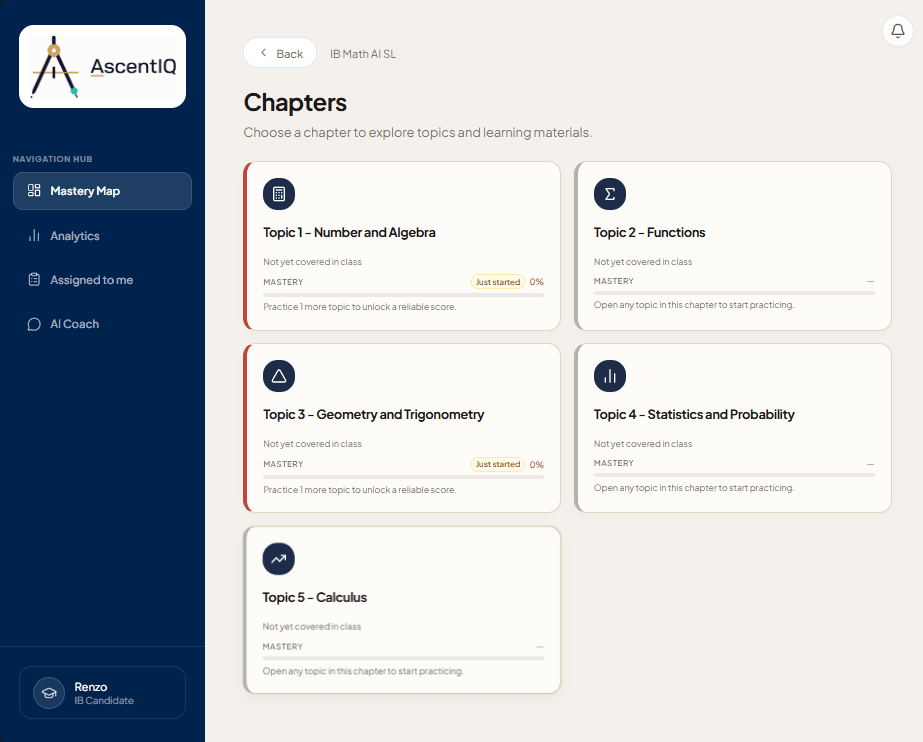
Pick a topic
Choose any topic in the Math AI SL syllabus. AscentIQ builds a new exercise on the spot — the numbers, the context, and the mark scheme are generated together.
02
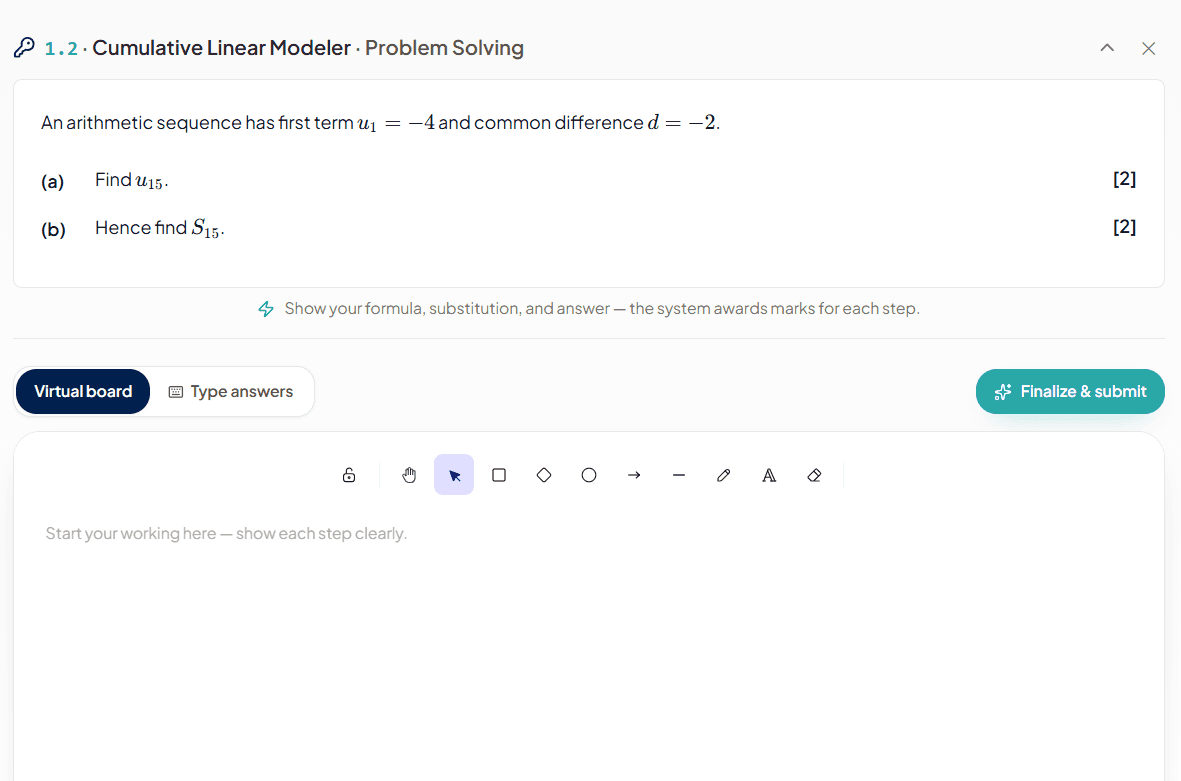
Work it out on the board
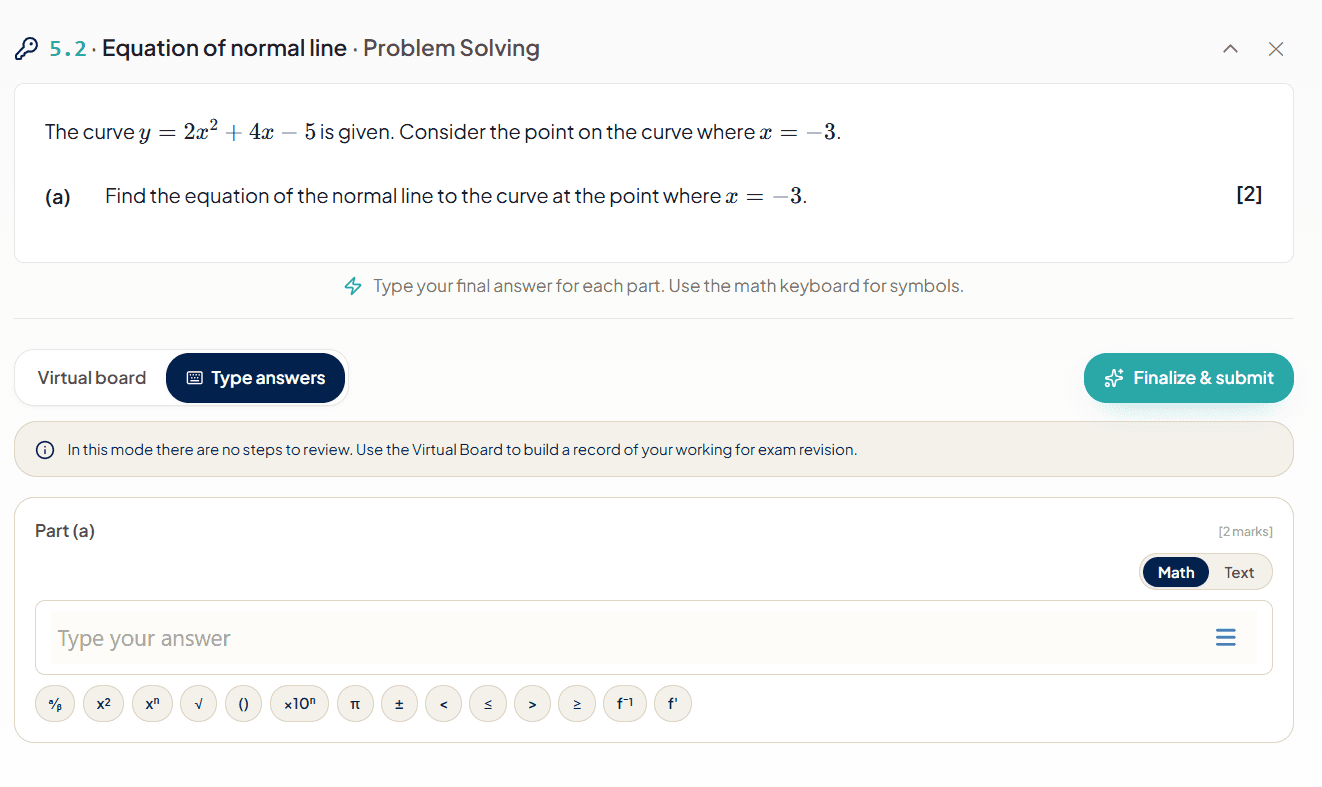
Write on the whiteboard as you would in the exam — that's where method marks are awarded, step by step. Or type final answers only, for a quick check.
03
Get marked in seconds
Your work is read line by line and marked against the IB scheme. Each mark is awarded or withheld with a reason you can act on.
Marks awarded
- M1Mark awarded. Correct method: substituted n = 10 into the formula.
- A1Mark awarded. Correct value: 47.
- R1Mark not awarded. No justification given for the choice of model.
04
See what to do next
Your mastery map updates immediately. It shows which topics are exam-ready, which need work, and what to practise tomorrow.
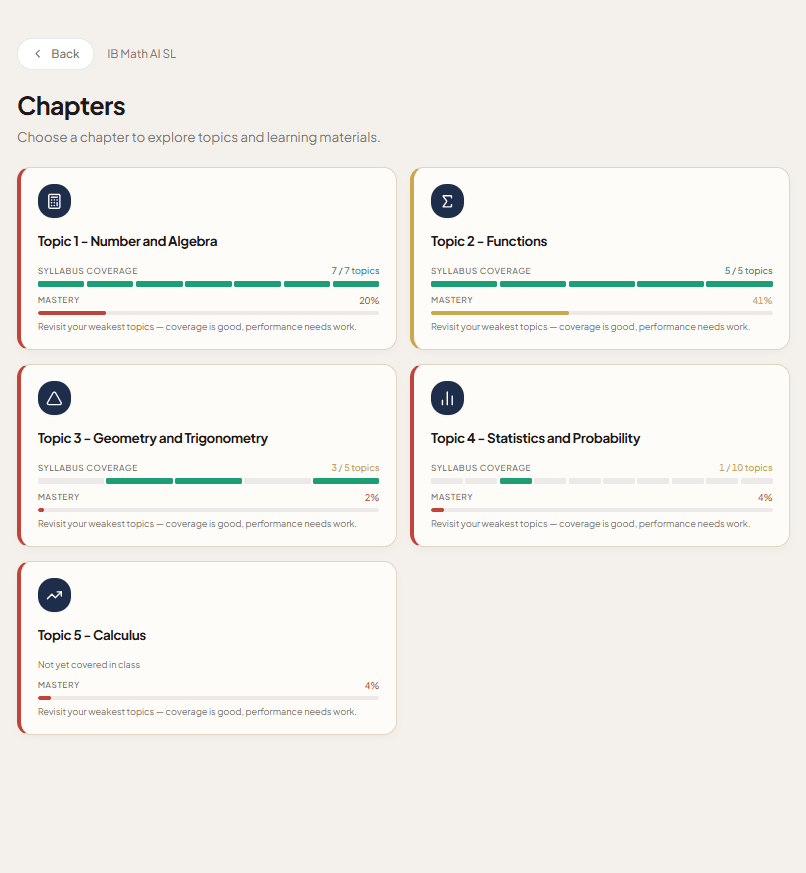
A score you can't game.
Most progress trackers average your scores, which means enough easy questions will eventually show green. AscentIQ caps a topic at 75% until you've taken full marks on an exam-level question in it — and weights the score by how much of the topic you've actually covered. Scores also decay if you stop practising, because knowledge does.
What's inside
Built for one exam. Calibrated to it completely.
The core
An examiner, not a grader
Generic AI marking gives you a percentage and a pat on the back. AscentIQ awards individual IB marks — Method, Answer, Reasoning — against the same scheme a real examiner uses, including GDC methods where the scheme permits them. You see exactly which marks you earned, which you lost, and the specific reason for each. Follow-through is respected: one early slip doesn't cost you the whole question.
Generation
Never the same exercise twice
Exercises are built procedurally from a seed, not pulled from a bank. Ask for the same archetype ten times and the underlying object is regenerated each time — new values, same examinable structure.
Handwriting
Whiteboard and OCR
Write your solution the way you will in the exam. AscentIQ reads your handwriting line by line, and corrects only what the scanner damaged — your own mistakes stay yours, and get marked as such.
Tutoring
AI Tutor
The tutor doesn't open mid-question. It opens once your work is graded, and walks through exactly where a mark was lost and why — so there's no shortcut to lean on before you've actually tried.
Guidance
AI Coach
Open it any time for a read on where you actually stand — what's improved, what's slipped, and what's worth doing next.
Pricing
Priced against a tutor, not a textbook.
One hour of private IB tuition costs about €60. A year of AscentIQ costs less than three.
Founding cohort — price held for as long as you stay subscribed.
€149
/year
€199
Everything you need to practise and be marked.
- Unlimited generated exercises across the full Math AI SL syllabus
- AI Examiner with per-mark feedback
- Whiteboard and typed input
- Mastery map
- AI Tutor
- AI Coach check-in
- Exercises in English or Spanish
7 days free, then €149/year. No card required to start.
AscentIQ is early-stage software and list prices may change as it develops. The rate you join at is held for as long as your subscription stays active.
Built for classrooms too
- Roster your class with invite codes — students join in seconds.
- Cohort analytics with drill-down to every student's mastery map.
- Review and override any AI-graded mark before it counts.
Are you a school? Institutional access is arranged directly — get in touch.
Who built this
Built by one IB Maths specialist, for one IB Maths course.
AscentIQ was designed and built by Renzo Diaz, who has spent years teaching IB Mathematics: Applications and Interpretation. Every archetype in the platform was mapped from the syllabus, past papers, and examiner reports by hand — 293 individual method marks annotated one at a time. That's why the marking behaves like an examiner's rather than a chatbot's, and why the platform covers one course properly instead of ten superficially.
renzo-diaz.comQuestions
Before you start.
IB Mathematics: Applications and Interpretation SL, completely — every topic in the syllabus, calibrated against real past papers and mark schemes. We cover one course properly rather than several superficially. Additional IB courses are on our roadmap; the Math AI SL depth is the standard we'll hold them to.
Your work is transcribed, then evaluated against the exercise's mark scheme one mark at a time. Each Method, Answer, and Reasoning mark is awarded or withheld with a written reason. Follow-through is applied, so an early error doesn't automatically cost you the marks that depend on it.
The maths isn't generated by AI. Every number in every exercise is computed deterministically before the AI is involved — the AI only writes the wording around values it's been given, and is blocked from producing numbers of its own.
You don't have to, but the whiteboard is where the marking is worth most. Writing out formula, substitution, and answer lets each method mark be awarded or withheld on its own. Typing takes final answers only — quicker, but there's no working to mark, and nothing to review afterwards.
A tablet with a stylus is the best experience — the whiteboard is built for it. A laptop or desktop works fully too. We wouldn't recommend a phone: the whiteboard needs more room than a phone screen gives it.
Seven days of full access — every topic in the Math AI SL syllabus, unlimited generated exercises, and per-mark feedback on the work you write out. No card required to start — we'll ask for one on day 7 to continue.
Founding cohort is open now and stays open based on demand, for as long as we're in this early stage of the platform. Founding members pay a reduced rate and keep it for as long as their subscription stays active, and they have direct input into what gets built next.
Subscriptions are annual and renew once a year. You can turn off renewal at any time from your account and keep access until the term ends.
Find out where you actually stand.
Seven days of full access. Every topic, every mark explained.
Start free trial